Frisland
1558 – 1660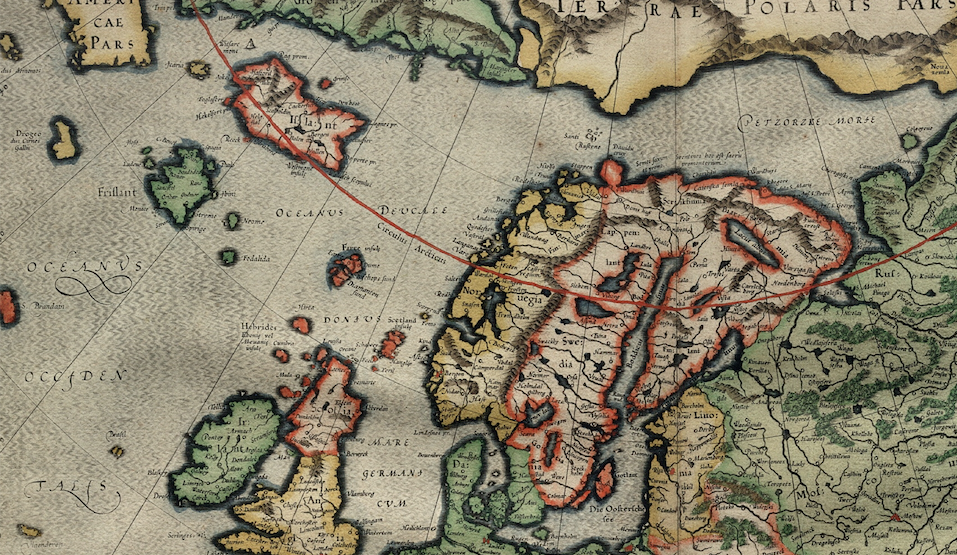
Where in the North Atlantic
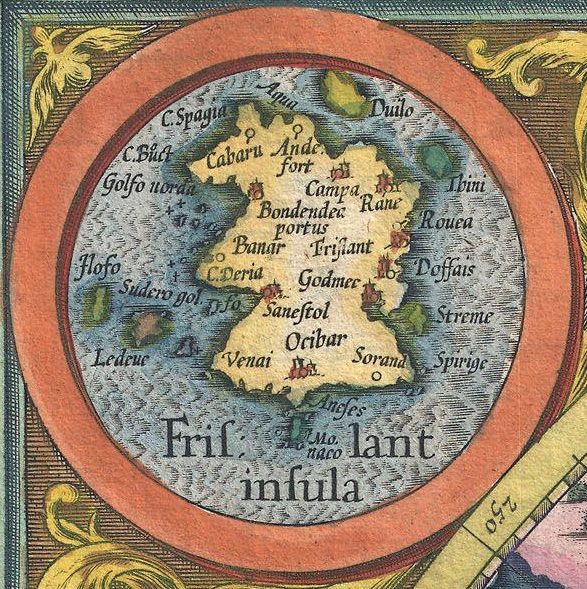
When appears on the Zeno map, published in Venice in 1558 by Nicolò Zeno but supposedly based on voyages made in the 1390s by his ancestor, also named Nicolò Zeno. Disappears from maps around 1660.
Also known as Fixland, Freezeland, Friesland, Frischlant or Frislandia
Could be Iceland or the Faroe Islands, or even a hoax1
Not to be confused with Friesland, a province of the Netherlands, called Friesland in Dutch and English and Fryslân in West Frisian.
Fixland
“I should warn you,” Jón tells Davíð, “I know very little about Sigrún’s work. She must’ve signed, like, a dozen non-disclosure agreements.”
Davíð answers with a smile. “No worries,” he says. “I’m not here to ask questions. But just to make sure we’re on the same page, can you go over what you know about teleportation?”
They’re sitting on a rocky outcrop, near the cliffs at the western end of Jón’s tropical fruit farm. The sun is low over the sea. They’re enjoying the last bits of light and heat before the cold Fixlandic night sets in.
This is a surprise visit. Fifteen minutes ago, Jón was tending to the pitahaya cacti—silly, palm-shaped succulents with snaky leaves and bright pink fruit, the kind of crop that should definitely not grow in Fixland’s subpolar oceanic climate—when he heard the characteristic sound of Davíð’s vintage car on the farm lane. Davíð is a childhood friend of Jón’s, but they barely see each other now that Davíð is a VIP as an elected member of the Althing. Davíð pretended to have done the two-hour trip from Ocibar just to see his old friend, but of course that couldn’t be the whole truth, so Jón told him to cut the bullshit.
Cut the bullshit he did, and now they’re talking about the latest physics research: teleportation. Which happens to be what Jón’s wife is trying to invent.
“I just know the basics,” Jón begins. “Her lab was studying the source code, as usual, when they found the part of memory where the simulation keeps the coordinates of every object. Sigrún told me she’s been figuring out the mathematical rules that can be applied to these coordinates. If you’re careful, she says, you should be able to change the position of any object, which means moving it anywhere you want—instantly, regardless of distance.”
“That’s about right,” Davíð says. “Did she tell you they began running tests?”
Jón is surprised. “Did they? I thought her work was mostly theoretical still.”
Davíð nods. “They’ve already conducted successful trials with small objects. A bottle, a banana, that kind of thing. Small animals, too.”
“I had no idea.”
“Sounds like your wife has been complying with those NDAs pretty well, then,” Davíð says with a grin. “I should add that the tests went perfectly fine. They got approval from the Althing ethics committee at every step, of course. The first object they teleported was the most inert material they could find—a lump of iron. They transferred it from Port Bondendea to a university lab in Ocibar and back. Then they did experiments with other objects, always reverting everything to the initial state. Recently, they teleported stuff without bringing it back, in order to study the long-term effects. So far, nothing to report.”
“Okay,” Jón says, taking this in.
“Since everything has been going so well, they think they’re ready for the next step. I’m sure you can guess what.”
“They want to teleport a person,” Jón says.
“Yup.” Davíð suddenly wears a much more serious expression. “I don’t need to tell you this is a different category of risk entirely.”
There are (as of today) 21,558 people in the Fixland Archipelago. This is a small number, when you put it next to the tens of millions of other objects that make up the Zeno World. And yet, approximately 60% of the computing power that runs the universe is used to model these 21,558 minds and bodies.
Take a banana, or a dragon fruit: it’s a mere matrix of atoms, each associated with a bunch of variables that describe its color, texture, or taste. Now take a person, a conscious person, with the same physical and cognitive capacities as an Earther. Like the piece of fruit, she’s made of atoms—but they’re bundled with whole layers of loops and subroutines that give her the ability to perceive her environment, to experience emotions, to remember past events, and so on. Her physiology isn’t quite as detailed as it could—cell theory isn’t true in the Zeno World—but she can still become fit by training, for instance, or get sick from overeating. She is the most sophisticated object around.
Sure, you can probably change her location by messing with the source code. But are you willing to risk introducing bugs to such a complex system?
“The Althing met last night,” Davíð says. “Extraordinary session. You see, the ethics committee couldn’t reach a consensus on human teleportation trials. So they referred the case to the Althing as a whole.”
“And?”
“And we’re also undecided. The vote was 20 yeas, 19 nays.”
“So you are authorizing the experiment,” Jón says.
“No. For matters of ethics, we require a two-thirds majority. We’ll have to submit the question to the entire population.”
Jón takes a moment to consider this. A public debate, all over Fixland, on the project to which his wife devotes her work life. Well. Sigrún has been surprisingly secretive so far, but Jón assumes that they’ll be discussing it a lot more, from now on.
That being said, Jón doesn’t quite get why the question is so complicated. Bugs are a possibility, all right. But they wouldn’t be the first. In the past, Nicholas, who is also called God, has always intervened to rectify whatever went wrong. Surely He would do it again—right?
“Yes, hopefully,” Davíð says in a low voice.
Far in front of them, the sun makes contact with the horizon. Sky and sea are blooming with color. One of Nicholas/God’s design choices in creating Fixland was to emulate the natural beauty of Earth—and with sunsets, He has definitely hit the mark. Jón and Davíð say nothing, content to watch the solar disk pretend to disappear behind the curvature of the world, as if it were now shining on another expanse of the limitless ocean.
In fact, it is merely turning off. Tomorrow it will turn on in the east. The sun is a fancy ceiling lamp, cruising the sky every day (whatever the sky is) according to a model of Earth’s astronomical cycles. As for the ocean, it isn’t anywhere close to “limitless.” It has a square shape, 256 kilometers wide on both the north-south and east-west dimensions. At its thinnest, the distance between the Fixland Archipelago and the outer edge of the ocean is only 9.6 km.
Back when Jón was a student, a team of researchers chartered a ship and traveled to that boundary. No one had ever done this—what would have been the point? But these intrepid scientists wanted to learn more about the mechanics of the world, and so they valiantly sailed into the unknown. It turned out sailing into the unknown had not been an intended use case. The moment the prow of the ship hit the ocean’s edge, the whole simulation went into an unstable state. Many among the crew and research team vanished, just like that. Others froze—their bodies and minds became suspended in time, impervious to all physical phenomena. Jón’s grandmother, a sailor, was one of the “lucky” few who remained conscious throughout the ordeal, though her clothing did freeze in time, which meant she couldn’t move and had to wait the whole thing out. Meanwhile, the calculations involved in a number of physical laws, including gravity, started to fail. Everywhere in the archipelago, objects began moving in unpredictable ways. Many a piece of precious glassware or electronic device was destroyed from falling sideways onto things that weren’t, and lots of people got hurt, although, thankfully, there were no fatalities. Jón holed up in his apartment, wondering if and when the chaos would end.
It did after two days. Nicholas released a patch, blamed an overflow error. His miraculous intervention quickly made everything all right, barring some manageable damage He couldn’t or wouldn’t repair. The ocean’s boundary became a safe invisible wall. Nobody checked, though. Soon after the disaster, the Althing prohibited all seagoing vessels from wandering more than two kilometers away from the shores. It’s not like there were any terrae incognitae out there, anyway.
“Going to the ocean boundary was risky,” Jón says, “but we did it anyway. Don’t you think it’s the same thing?”
“I don’t know,” Davíð says. “That was nine years ago. Miracles weren’t exactly common back then, but they did occur on occasion. Lately …” He pauses. It’s colder now, so he stands up and stretches, looking handsome in the dying light. For a brief moment, Jón is reminded of the time he had fallen in love with his friend, long ago, before he had his sexual orientation switched.
“Lately,” Davíð continues, “miracles don’t seem to be happening at all. A colleague of mine, councilwoman Júlíana Jóhannsdóttir, performed an analysis on theological data. She found that no true miracles have been recorded in the past three years and a half.”
Jón joins him as he walks to his car. “Are you suggesting—”
“Yes. The non-intervention hypothesis. The idea no one wants to believe in.”
“Do you?”
“I don’t really know anymore.”
They get into the car and drive the short distance to Jón’s house, at the eastern end of the farm. They pass the dragon fruit cacti, and the field of budding pineapple bromeliads, and the mature orchard of banana trees. All these plants are growing at the same rate, thanks to Nicholas’s half-assed attempt at modelling agriculture. Also, none of the crops ever rot, which is why Jón’s business model is built on growing huge quantities of two or three kinds of fruit, storing it all, and selling it over the next few years while he picks some new varieties to have fun with.
Like all farmers, Jón has always assumed that this was a temporary state of affairs. One day, Nicholas will get around to finish the work, and they’ll be forced to grow barley or raise sheep or something.
Unless He doesn’t. It’s true that His involvement got steadily less frequent over the years. Jón’s grandmother used to tell him stories about her youth, which was the time right after Creation: Nicholas was still carving the world, and miracles, even major ones, were a daily occurrence. You could wake up to new birdsongs because a biodiversity update had been rolled out during the night. Or you could notice, one day, that you actually had a shadow, thanks to improvements in the light tracing algorithms. Nicholas also weeded out the bugs, sometimes almost as soon as the Fixlanders reported them through the terminals in the temples. Nowadays, bugs aren’t as severe, but they also rarely get fixed, if ever. And no one younger than 30 can remember the last time a major feature was released.
“A growing fraction of the Althing does worry that the hypothesis is true,” Davíð says as they approach the house. The windows are still dark; Sigrún is working late at the lab, once again. “And that’s one of the main arguments against the trials. We have to take into account the possibility that God won’t repair the damage we cause, this time.”
“I realize I haven’t asked what your vote was,” Jón says. “But I think I can guess by now.”
Davíð parks the car in the driveway, and gravely looks out at the sky for a few seconds. The stars—pinpoint illusions—are lighting up, one by one.
Then Davíð turns to Jón. “I’m going to be organizing the public campaign against human teleportation,” he says. “That’s what I wanted to tell you. I’ll understand if you take your wife’s side, I really will. But I hope I can convince you that we should not, under any circumstances, authorize her experiment to go forward.”
The only miracle to have ever personally affected Jón happened at the end of his teenage years.
He had known for a long time that he was attracted to men. He had told almost no one. Not that it was particularly taboo, in Fixlandic society. Everybody knew that sexuality was modeled faithfully—though with a fair amount of simplification—after the behavior of the Earthers, and that gays made up somewhere close to 6% of the community. But Jón lived in the small village of Banar (population: 112). The odds of meeting someone weren’t great. And he was in love with his best friend. Davíð, of course, had been supportive when Jón had expressed his feelings to him. But the rejection hurt, it hurt a lot, whatever Davíð could do. On a day where his mood had hit an especially abysmal level, Jón had paid a visit to the local temple. He had opened the terminal and typed a prayer in the software that allowed you to communicate with God.
The sexual orientation of a Fixlander isn’t complicated stuff. Gender is perfectly binary here, so there’s simply one bit called “attractedToWomen” and another called “attractedToMen.” Bisexuals have both bits set to 1; for asexuals, they’re 0. Easy enough for Nicholas to change one bit or both. But He wouldn’t just do everything the Fixlanders asked of Him. Contacting Him was a roll of the dice.
A couple of weeks later, Jón attended a party downtown, at a student house in Ocibar. Davíð had brought him here, in the hope that he would meet other boys and feel better about himself. Jón was reluctant, but, encouraged by Davíð, he spent some time chatting with one of the elusive young gays of Fixland. To his surprise, however, he soon noticed that he was in fact more attracted to the female friend who accompanied the guy. Her name was Sigrún and she was a physics student at the archipelago’s sole university.
Within a month, they were dating. The next year, they got married. She is the love of his life.
Jón often thanks God for making them compatible.
Just as foreshadowed by the Althing’s vote, the Fixlandic population is divided. An opinion poll suggests that 45% oppose human teleportation while 43% support it. Society splits neatly into two camps, and the fault line soon becomes visible in the media, on the intranet forums, and in the daily life of disagreeing couples.
Jón and Sigrún haven’t exactly disagreed, but they have been discussing every dimension of the problem over the past few weeks. Tonight, though, they’re just enjoying a quiet read in bed. Tomorrow is an important day: Sigrún will be traveling to Ocibar to take part in a televised debate. She will champion her lab’s project against sociologist Erika Brigittadóttir, one of the most respected intellectuals of Fixland. A week before the vote, the debate promises to be a highlight of the campaign.
“Throw some questions at me,” Sigrún suddenly asks, closing her book.
Jón looks up at her. “Again?”
“Please? I know I’m not falling asleep anytime soon.”
Jón and her have toyed with the question so many times he can’t imagine that they’ll find any new angle, but that doesn’t matter. What Sigrún wants right now is practice.
“All right.” Jón thinks for a moment. “Um. The island of Fixland isn’t that large, so the benefits of a teleportation system are necessarily limited. Is it really worth it to develop this new technology?”
Sigrún sits up in bed. Even with her pajamas and messy hair, she manages to look professional. Beautiful, too.
“Well,” she says, “I had to drive for two hours and a half, this morning, to get here in Ocibar, and I will be driving again tomorrow to get back home. Five hours spent on the road rather than with my husband in our farmhouse. Instantaneous transportation would save me—would save everyone—a great deal of time. It would improve our quality of life. And that’s ignoring the additional economic benefits, which of course are aplenty.”
“Nice of you to mention me,” Jón says.
“Our PR director says it helps to plug personal details,” Sigrún explains. “Okay, next question.”
“Um. Hours spent on the road give us an opportunity to enjoy the beautiful landscapes of Fixland. Don’t you think that, uh, teleporting between towns and villages will empty the countryside?”
“We’re not stopping anyone from going on a holiday. If someone wants to travel the island’s scenic roads, good for them! But they won’t be forced to do it just to move from one town to the next. What’s more, teleportation will make it easier for people to go sightseeing far from home.”
“Are you certain that God approves?” Jón asks. “He could have allowed us to teleport the moment He created the Zeno World. But He didn’t. It must mean something.”
“We asked Him. Many times, in fact. He hasn’t replied. Theological theory on the topic is clear: Nicholas’s silence should not be interpreted as either approval or disapproval. And in any case, if He wants to stop us, He can.”
“As the maritime boundary case showed nine years ago, you could introduce damaging new bugs—”
“—and that’s a major concern, of course,” Sigrún says. “We’re acutely aware of it, so we’ve been working hard over the past twelve months to anticipate and guard against all possible bugs. Our tests on both inanimate and animal subjects allow us to be confident on this matter.”
“But we’re talking about human beings.”
“If we want the technology to work for people, it has to be tested on people. Consenting people, obviously.”
“Will they be informed of the risks?”
“Of course—”
“So you recognize that there are risks.”
Sigrún shoots him an amused look. “Do you know you’re an excellent devil’s advocate?”
“Thanks. You’re really good at this, too.”
“Practice makes perfect! So, yes, of course there are risks, but we’ve worked hard to minimize them, we performed all the necessary checks, and so on and so forth”—she yawns, all of a sudden—“and clearly that’s enough for tonight. Let’s try to sleep?”
Lights out. Jón turns on his side, but doesn’t fall asleep right away. After some weeks of thinking, he still doesn’t quite know whether he’s for or against the project. On the one hand, Sigrún is convincing. This is her life’s work, and Jón is happy to see her grow enthusiastic when she describes the possibilities opened up by teleportation, or the fascinating theoretical implications of her research. Of course he supports her.
But on the other hand, he can’t help but think that Davíð might be right. As might be the more conservative politicians and intellectuals. As might be the theologians, who worry about the apparent lack of Nicholas’s involvement in worldly affairs. Never before has an experiment modified the state of the simulation this directly. Sigrún et al. have no doubt taken every conceivable security measure, but will that be enough?
Is he a good devil’s advocate, or does he actually, secretly, want his wife to change her mind?
It turns out he, not Sigrún, is the one suffering from insomnia. He gets out of bed, goes to the living room, and switches his projected computer interface on. A few more seconds and he’s connected to the internet.
Unlike the intranet, Fixland’s local network, not everyone uses the internet. Most people don’t even have access, though getting it is easy enough: just email a request to the university library. It seems that the typical Fixlander prefers not to think too much about the universe in which God dwells, and in which the Zeno World is but a server in God’s suburban basement.
Jón, however, nurses a deep fascination for the internet. He obtained his access years ago, when he was a student in Earther history, and has been using it routinely ever since. He knows he will never visit Earth; and yet he can’t help but read its encyclopedias and digitized books, appreciate its works of art, watch its movies, listen to its music. Some of all that is available through Fixlandic companies that curate and distribute Earther media, but there’s always so much more if you drink directly to the source. Jón cares very little about the real-time stuff, like online communities or current events, since time passes 10 times more slowly on Earth than in Fixland. But he doesn’t feel like he’s missing out. Even if you see the internet as a giant archive, giant is the keyword here—there’s just so much to learn. The immensity of this metaworld is difficult to even conceive, and while that can be upsetting to most Fixlanders, that is exactly why Jón is so much into it.
Jón browses at random. He follows links without finishing reading the articles. He opens dozens of tabs. One thing leads to another (that’s a basic property of the internet), and he ends up on a website about atheism.
He already knew that many Earthers put the existence of their God in doubt. That those who do believe don’t necessarily agree on God’s identity, or on the rituals to be used for communication, or even on the number of deities. Yet atheism and its opposite, religious faith, have both always seemed strange to Jón. In Fixland, the existence of Nicholas is a provable phenomenon.
The website’s anonymous author attacks the Bible, especially the Old Testament. They bring up the contradictions and the inconsistencies. They raise the following question: if God appeared—or at least sent unmistakable signs—to Abraham, to Moses, or to Mary, if he performed dozens of miracles in ancient times, why does he not do this anymore? Why is it that, in this scientific age, the only “miracles” we get are dubious testimonies, indistinguishable from chance or from the placebo effect?
From this observation, the author writes, we conclude that one of the following must be true. Either God does not exist. Or he does, but he quit meddling in the world after the Biblical times were over. Either way, humanity must be considered in charge of its own destiny. People can’t defer to a higher force if things go wrong. They have no one but themselves.
Jón goes back to bed, but he doesn’t fall asleep until dawn, just as Sigrún wakes up and gets ready to leave for the city.
Sigrún’s debate performance is sensational. Poor Erika Brigittadóttir, though an experienced polemicist, comes across as amateurish and badly prepared. The decisive moment occurs when Sigrún asks her if she thinks they should outright give up all technological progress. Nicholas hasn’t introduced any new features to the Zeno World in years. If Fixlanders themselves are too afraid of bugs to push the limits of what’s possible, does that mean they should settle for perpetual stagnation? Erika stammers out something about how most experiments are risk-free, but she hadn’t seen the question coming and it shows.
A week later, the results of the referendum are unequivocal: 58% for, 42% against.
In the lab’s conference room, Sigrún and her colleagues celebrate. Jón, who accompanied his wife, pretends to share their joy, but he spends most of the evening at the buffet, munching crudités. After a while, he heads outside and calls Davíð. A video chat window opens in the cool night air.
“I assume you’ve seen the results,” Jón says to Davíð’s image. “I’m sorry.”
“Don’t be!” Davíð replies. “That’s what politics is all about. The people have spoken. Now, we can only cross our fingers and hope everything goes well. Which it probably will.”
Jón hesitates. “You know, I … I realize it’s late to say this, but I think I agree with you in the end. Maybe I should’ve worked for your campaign.”
“No, don’t worry about it. You were stuck between a rock and a hard place. By the way, offer my congratulations to Sigrún, if you would.”
“Sure. I will.”
He goes back inside the lab, where Sigrún is being interviewed by a journalist. She announces that the first human trials are scheduled in a month. An apparatus will be set up in Ocibar and another here in Port Bondendea. Anyone interested in being an experimental subject can contact the research group. A strict informed consent protocol will be followed, and there will be, of course, generous compensation.
Jón wonders what Nicholas thinks of the whole thing. Does He have an opinion? Is He curious about what the residents of His simulation are doing?
Is He even aware of what’s going on?
The first person ever to be teleported is a young man named Gunnar Gustafson. An overnight celebrity, he describes his experience to the media. The teleportation process causes no weird sensations, he says, except that the environment around you changes unnaturally fast, not unlike a cut between TV scenes. It’s slightly disorienting for a few seconds, and that’s it. No side effects are recorded either in Gunnar or in the area around the transmitting and receiving devices.
A precious few people remain skeptical, but most of the critics are reassured. The technophiles are exultant—this is Fixlandic ingenuity at its best! Progress is marching on, making everyone’s life better. Not long after the first trial runs, Sigrún teams up with engineers to found a company they name TelePort Technologies. It specializes in the construction of a network of teleporter stations. First, they will link the towns and villages, then the minor islands of the archipelago, followed by a large number of points all over the countryside and even in the deserted interior of Fixland. When they’re done, no one will ever be more than a few kilometers away from the nearest teleporter.
Months pass and everything goes well. Sigrún still works a lot at the lab, now as the company’s CTO; Jón takes care of the farm. After growing more pitahayas and pineapples than all of Fixland could eat in a year, he’s now into lychees and passion fruit. Since all crops have the exact same properties, this isn’t very challenging. All things considered, it would be more interesting to be a farmer if Nicholas built a realistic model of agriculture.
The TelePort network opens to the public a year, almost to the day, after the maiden teleportation of Gunnar Gustafson. It’s an instant commercial success. Invent a technology that meets a need, and even those who weren’t thrilled will eventually adopt it. Before long, most trips between the main towns of Ocibar, Campa, Sanestol or Godmer are done by teleportation.
Jón tries it with Sigrún. Together, they drive to Port Bondendea, teleport to Ocibar, spend the evening with friends, and go back home by the same means. Total duration of the trip: three hours, only thirty minutes of which were spent on transportation. It works so well that Jón feels he has to apologize for his lack of trust, early on.
It works so well, in fact, that several more months go by before the first bugs are noticed.
One afternoon, Jón and Sigrún are biking on the seaside trails of Ibini, an island recently connected to the network, when Sigrún’s phone chimes three times, signaling an urgent message. They stop at a rest station while she checks her screen.
“Who is it?” Jón asks.
“It’s Einar,” she says. Her cofounder and CEO. “Sorry, this looks important.”
She sets her bike against the fence and takes the call. In front of her, an intranet window appears, with Einar in it. Jón kills the time by wandering around the nearby pebble beach. Ibini is one of the most lovely islands of the archipelago, and the landscape—rough stone battered by the sea, dunes of grass undulating in the wind—is gorgeous. But Jón quickly loses interest. He’s more intrigued by the snippets of conversation that he can catch, so he walks back to his wife.
“What do you mean, ‘doppelgängers’?” Sigrún sounds frustrated. “Please explain, Einar, I don’t get it.”
“I don’t get it either, Sig,” Einar’s warped voice says. “You’ll have to speak with Karla; the programmer who spotted the problem works in her team. I believe Karla’s the one who came up with that word, doppelgänger—”
“How serious is it?”
“I’d say, ‘rather’ to ‘very.’ Look—just now, I’m writing a press release to announce the temporary shutdown of the network.”
“What?” Sigrún says, incredulity raising her pitch.
“Karla estimates that there are currently anywhere between twenty and fifty doppelgängers in the wild. We definitely don’t want more. How much time do you need to get back to the lab?”
“Half an hour, an hour.”
“Without teleporting, I mean.”
“Uh, we’re in Ibini, it might take … I don’t know, a while.”
“Just be on your way as soon as possible, okay?”
They hang up. Einar’s face disappears, and Sigrún remains quiet for a moment. Then she lets out an epic and totally uncharacteristic string of expletives.
“Um, what’s wrong?” Jón asks, startled.
“What’s wrong is that we need to fucking go home. There’s a problem with the network. Where can we take a boat?”
They bike back to Ibini’s small harbor village. By the time they get there and return their rented bicycles, it’s the early evening. They walk to the ferry office on the pier, only to discover it’s closed. A helpful passer-by informs them that they’ve just missed the last departure of the day. Business hadn’t been great lately, the woman explains, so when teleportation took a big share of the market, they had no choice but to cut back on the number of crossings. Besides, she continues, did Sigrún and Jón know they can just use the teleporter down the street? It’s cheaper than the ferry, too! Sigrún makes a heroic effort to hide her anger, and they head to the local motel for the night. She spends the next four hours in a succession of phone conferences, writing tons of emails on the side and updating Jón whenever she has a minute.
It all began with a series of harmless glitches in the village of Sorand. Miscolored atoms, scrambled text, nothing more. The village’s authorities submitted a bug report at the temple, as per procedure. But the unusual density of the abnormalities put them on the trail of a woman who, upon being questioned, was deemed incoherent—deranged, even. Before long, the police understood that she was the defective double of somebody else. They suspected teleportation. A few hours later, some TelePort employees found and confirmed the problem.
In rare cases, the relocation algorithm creates a glitchy clone of the traveler. This so-called doppelgänger may materialize anywhere in the Zeno World. It doesn’t usually survive long. Some of them turn up in the middle of the ocean; others appear half a kilometer above the land before falling to their deaths. Most are downright dysfunctional at the biological level. But a few are “blessed” to look like regular people and pop up in plausible locations, allowing them to fit in ordinary life. And everywhere they go, they corrupt the code of the world.
It’s a mess.
“Can you fix it?” Jón asks. They’re in the motel room, eating a quick meal of fish and chips.
“Depends what you mean,” Sigrún says. “We can probably prevent the bug from happening again. But the impact of the doppelgängers is difficult to measure right now. There’s a chance they’ll cause a cascade of errors, and then—” In what has become a common pattern during the evening, her phone’s ringtone interrupts their talk. “Sorry again. I need to take this.”
She goes to the bathroom to answer. Meanwhile, Jón struggles to eat the rest of his fish. He feels a heavy weight in his chest, as if he were partly responsible for this whole misfortune. He should’ve at least tried to convince his wife to abandon the project. Then again, he probably would’ve failed. There’s really no point in ruminating over this, and yet he knows he will keep doing exactly that for a while—until, at least, somebody manages to patch up the problem.
By the time they get home the next morning, after the ferry crossing to Rane and a taxi run that costs them an arm and a leg each, all of Fixland is on alert.
The TelePort network is out of order. The few known doppelgängers have been apprehended by the authorities and confined to a detention facility, where they will await judgment on—well, on whatever needs to be done with them. Their existence itself raises a moral question: are they real people? They look conscious—are they? While the ethicists ponder this, the police set up a security perimeter around each area where a doppelgänger was seen.
The hope is to stop the spread of potentially harmful glitches. Everyone who has a doppelgänger is healthy, it seems, but direct contact with the doppelgängers is hazardous. Some individuals have been admitted to the hospital for issues that are evidently related. One of them, a man who had helped an elderly doppelgänger lady cross a street, suffers from having his left arm positioned exactly 38.1 cm in front of its usual location. The arm is still fully functional. Another patient (whose turbulent kid really was in two places at once, after all) now speaks exclusively in a mix of two languages that are established to be Basque and Tagalog. Keeping with the theme of linguistic anomalies, a police officer discovers that whatever she writes instantly turns into a jumbled mess of question marks, Ethiopic letters, Simplified Chinese characters, and emoji from the food and drink category.
After Sigrún has left for what promises to be a long day of crisis management, Jón turns on the TV. He’s mildly surprised to see Davíð, along with two other representatives of the Althing, at what appears to be a press conference. The councilwoman who’s responsible for security is speaking. She describes the measures taken by the government, insisting every few sentences that the population should not panic. She announces a moratorium of indefinite duration on experiments involving the source code, and the creation of a special force for glitch detection and removal. She concludes by urging the population not to panic, and then journalists start asking questions.
“My question is for councilman Davíð Ragnarsson,” one of them says. “I realize it’s early to ask this, but considering the seriousness of the situation, are you hoping for divine intervention? And if that doesn’t happen, are there any scenarios in which we solve the crisis on our own?”
Davíð remains quiet for a moment, exchanging a look with his colleagues. “Yes,” he finally says, “it would be helpful if Nicholas got involved. In fact, we’ve already made use of every known means of communication to contact Him. We’re hoping He will answer promptly.”
He seemingly ignores the second part of the question. This can only mean one thing, Jón realizes. They have no idea what to do, except trust that God will come and clean up the mess.
Jón shivers.
Days go by and nothing improves.
Twenty-one doppelgängers have been arrested, but many others are evidently out there. Abnormalities are piling up. The most spectacular one occurs a week after the beginning of the crisis: the detainment center where the doppelgängers are kept, on the island of Monaco across from Ocibar, undergoes total deconstruction. Turrets and windows are suddenly replicated all over the place; many surfaces get the wrong texture mapping, glass becoming brassy metal and brick taking the iridescent patina of soap bubbles; some walls start blinking in and out of existence. The island, now a mad surrealist painting, is put under strict quarantine. From afar, onlookers watch as the facilities slowly take new shapes, each more impossible than the last.
The temples, especially the Grand Temple in Ocibar, are stormed by the crowds. Everyone wants to send their prayer to Nicholas. Everyone wants to believe that they’re being listened to, to indulge in the hope that the world will be repaired. But God doesn’t send a sign. Not to the Althing, not to anyone.
Meanwhile, the intranet and the media are ablaze with commentary and opinion pieces. The referendum is reexamined as a critical moment of recent Fixlandic history. Praise is showered on the skeptics and the pessimists. In a televised panel, Erika Brigittadóttir even alludes to potential lawsuits against the inventors of TelePort. That night, when Sigrún comes home from the lab, tears are running down her face and ruining her simple makeup. Jón consoles her as best he can, but how do you comfort somebody who’s accused of having committed a monumental mistake, and who agrees with the accusation?
Jón himself finds solace in his daily routine. The lychees are ripening, and he has just planted a patch of spiked melon. To relax, he spends a lot of time on the internet. One drizzly morning, he figures that the Earthers’ problems might offer a nice distraction from the Fixlanders’, so he opens a bunch of news websites. The last time he read up on Earth’s current affairs must have been … three or four years ago, maybe. Divide that by ten, and you get the equivalent of a season. What might have happened on Earth over four months?
Almost nothing, it seems. He goes through news articles he’s pretty sure he’s already read, years ago. Weird. He looks at the dates, but he’s forgotten too much of what he knew about the Gregorian calendar for that to be of any use right now.
Maybe there’s a bug in the internet?
Sigrún shows up in the living room, in a bathrobe, her hair undone. She’s not in a good mood. Two days ago, she resigned from her position as the CTO of TelePort Technologies, and since then, she hasn’t been doing much. Jón hugs her, tells her he loves her. He’d do anything to cheer her up, but so far all his efforts have come to naught. She needs time.
Time—or lots of busy farm work. Jón and Sigrún spend the afternoon in the orchard, harvesting the lychees and trimming the passion fruit vines, and this actually helps a lot. Sigrún forgets some of her worries as they joke and laugh and tease each other. It is a beautiful, healing moment. At night, exhausted by the physical work, Sigrún goes to bed early, and Jón decides to go back online.
There’s nothing new on the internet. No articles published after March 3rd, 10:35 PM, in any media organization of any country, language, or time zone. Nothing on the forums, either. Yet Jón hasn’t been online for the past ten hours. At least some things must have happened, over a one-Earth-hour period.
Well, okay. The internet isn’t updating anymore, but that might just be a connection problem. Maybe the doppelgängers are responsible. Or—one can hope—maybe Nicholas disabled some stuff because He’s debugging the Zeno World right now. Tomorrow, if the bug isn’t gone, Jón will drive to Port Bondendea Temple and file a report. That’s his civic duty, even though he’s not exactly hopeful that God will do anything about it.
First, however, he should investigate some more. He navigates to a very popular discussion platform, the kind of website on which, at any given time, many more users are logged in than Fixland has people. Here, in Earth’s frame of reference, there’s at least one new comment per second, and often many more.
Jón repeatedly refreshes the page. It is as lifeless as the rest of the web.
Oh, maybe not: a new comment has just come up. Jón writes down the date (March 3rd) and the time (10:35:57 PM), and keeps refreshing. After another five minutes, a second message appears, timestamped at 10:35:57 PM. The same time, down to the second.
Jón installs a plug-in to refresh the page automatically. He monitors the Earth-time and the Fixland-time of each incoming message, watching for the moment the Earth-seconds will increment from 57 to 58. This eventually happens, twelve Fixland-minutes after the first message he saw.
He keeps going for a while, which ultimately allows him to calculate that 1 Earth-second amounts to 16 Fixland-minutes and 40 Fixland-seconds—that is to say, a thousand seconds.
A sinking feeling overtakes Jón as his mind arrives at the obvious conclusion.
No miracle has been recorded in Fixland in … five years, give or take. Five years is 1,826 days. Divide by one thousand, and the comma conveniently turns into a decimal point. 1.826: not even two days. Not even a weekend.
The non-intervention hypothesis is true. Not because Nicholas forgot about the simulation. But because He accelerated it beyond His own ability to intervene.
Which makes no difference. They’re in a godless world.
Jón had been toying with the idea, but—as he now realizes—he hadn’t seriously considered it might be true. Now that he does, he feels … cold. Alone. Nauseous. His breathing quickens; he starts shaking.
He runs outside. The farm is quiet and pitch-dark. He sprints across the fields, stumbling a little, all the way to the western cliffs. He stops at the fence, a fortunate obstacle between him and the rocky beach twenty meters below. The ocean can be heard but not seen. Above, through holes in the cloud cover, a few fake stars shine weakly.
Jón lets out a formidable and very long scream.
If Nicholas happens to be listening, all He’ll hear will be a tiny bleep, barely longer than a hundredth of a second.
They knew. The members of the Althing. The university’s theology experts. A number of inquisitive minds who came to the same conclusions as Jón’s, and to whom it was politely yet firmly demanded that they don’t publicize their discovery.
Why?
Social order, Davíð explains as they walk on the Ocibar waterfront. Jón’s existential angst, were it to spread among the populace all at once, would bring generalized chaos. Especially in these trying times. Instead of praying, who knows what the Fixlanders might do?
“But if prayers are pointless,” Jón says, “what can we do?”
“Improve our understanding of the source code,” Davíð says. “Patch what we can. Our options are limited, of course. The hard part will be accepting the consequences of our tech experiments.”
“Don’t you think you should’ve told the truth, during the referendum campaign? You would’ve been more convincing.”
“We did consider it. Decided against it.” Davíð sighs. “I hate to say it, but we may have made a mistake.”
Across from the harbor, the absurd shapes of Monaco Island stand out against the overcast sky. Fifty-six doppelgängers—all of them, supposedly—are now detained there, living a secluded and utterly illogical existence. The structural disorganization of their prison gets a little worse every day. There’s a nonzero probability that they end up distorting the environment outside the island, perhaps even as far as Ocibar, so the Althing has decided to relocate them away from any populated areas. A new facility is being built in the remote volcanic highlands at the center of Fixland.
Jón and Davíð pause to gaze at the island. “What’s the long-term plan for them?” Jón asks as he leans against the promenade’s railing. “Life in prison?”
“It’s a … complicated problem,” Davíð says. “Some of the more normal ones send us messages, begging us to let them go. They say they haven’t done anything wrong—which, well, is true, but we can’t just release them either.” They resume walking. “Did you know one of them has given birth? A woman from Godmer was pregnant when she teleported—and now her child has an evil twin on that godforsaken island.”
“That’s fucked up,” Jón says. “I wonder what will happen to that kid, growing up in such a bizarre place.”
“Well, the kid is probably bizarre to begin with. But yes, it’s intriguing to think about the doppelgängers’ future. Some researchers think they’re developing a culture of their own.”
“Like inmates, then.”
“Yes, you could say that,” Davíð says.
They leave the waterfront and head downtown, towards Davíð’s house. They pass the Althing building and then a municipal park. Half of it is fenced off. Some people who picnicked here developed a weird sense of olfaction—being able to smell, for instance, the color blue, the number 29, or “disappointment”—so it is suspected that a doppelgänger corrupted the area.
There are such restricted areas all over Fixland, now, some much larger than others. Just in terms of real estate, the damage is enormous. And it’s not over yet, even if no doppelgängers remain on the loose. Any object that interacts with a buggy object risks becoming buggy itself, and since perfect isolation isn’t feasible, the disorder keeps expanding, slowly yet unstoppably. Little by little, reality falls apart.
The Fixlanders are fighting back, of course. Nearly every physicist and programmer has been enlisted in a vast stabilization project. Sigrún is among them; she hopes to redeem herself, at least in her own eyes. But their grasp of the source code is too fragmentary. The mess is too deep and intricate. They won’t be able to debug it all; they need help.
And Jón now understands that no help is coming.
He and Davíð cross the plaza in front of the Grand Temple. The house of worship is full to the brim with people. Jón realizes that some weeks from now, it might very well be empty. Sooner or later, his fellow citizens will figure out, like he did, that God isn’t intervening anymore. Let the Althing members try to keep it a secret and preserve “social order” if they want—whatever they do, it’ll be increasingly hard to explain why God is letting a tragedy of this magnitude continue. Before long, the Fixlanders will know that they’re alone. They’ll know that they’re in charge of their own destiny.
With any luck, they won’t screw that destiny up, not any more than it already is.
Returning home from his spring break vacation in the Dominican Republic, Nicholas wakes up his desktop and casts a casual glance at the program running the Zeno World.
Shit. 200,000 critical bug reports?!
He looks in more detail. Of course. Once again, the people of the simulation have decided to try hazardous experiments. He really should reduce their scientific curiosity to near zero. But it’s so much fun to see them invent new things …
To be honest, he mostly shouldn’t have set the speed to 1,000x just before leaving for a week-long holiday. He wanted to let it run for a big chunk of subjective time, just to see what would happen. Well, there you go—half the archipelago lies in ruins, 75% of the population suffers from unspeakable illnesses, and an army of degenerate clones has overrun the capital city and several other towns, driving the people out to an ever-smaller safe zone on the outlying islands. This is … entertaining, to be sure, but not quite what Nicholas had wished for.
He pops open a can of soda and contemplates the list of requests. No way he’s going through this. He should nonetheless fix the more egregious problems, just to stabilize the code. Come to think of it, it’s remarkable—miraculous, even—that the simulation hasn’t crashed yet.
So, first, he should … ugh, no. It’s too much work. He’d better just restore a saved state.
He rummages through the pile of stuff on his desk. After some time, he finds his backup drive, connects it to the computer, and—
Oh, fuck me. I really haven’t made a backup in almost a year?
A quick calculation: about thirty years have elapsed in the Zeno World since the last backup, twenty of which correspond to the accelerated period during the spring break. Thirty years out of 11,000 people’s lives—erased. He feels a pang of guilt. But the only other choices are to let them live in this hell until the end of times, or suspend them indefinitely. That wouldn’t be moral, either.
Nicholas saves the current state of the Zeno World, just in case. Then he launches the backup recovery utility.
Reluctantly, Jón lets Davíð drag him through the partying crowd. They’re in a house near the university, in Ocibar. It’s full of students, the music is deafening, and the air reeks of pot and cheap alcohol.
“I don’t know anyone here,” Jón complains.
“That’s kind of the point, isn’t it?” Davíð says teasingly.
“I—”
“Listen.” They’ve reached the kitchen, where the music isn’t as loud and a few small groups are conversing. Davíð looks Jón squarely in the eye. “You may be the only gay boy in Banar, maybe even in all of Sanestol High School. But you’re not the only one in Fixland. This place is full of them. Go meet some! You’ll feel much better afterwards. And who knows, you might even meet the someone.”
Jón lowers his voice. “Please, Davíð, I haven’t told anyone else yet.”
“And it’s about time you did!”
Davíð is pulled into a group of university friends, and Jón ends up by himself in the kitchen. Noticing the buffet table, he decides that the best complement to his sullen mood is to pile up various unhealthy snacks on a paper plate and eat it all broodingly.
Davíð suddenly reappears and hands Jón a beer. “All right, now you go talk to someone.”
“Who?”
“Anyone! Some guy you think is cute. How about him?” Davíð points to a guy who’s hanging out with a girl, in a corner of the living room.
“We don’t know that he’s gay,” Jón says.
“Oh, come on, he looks super gay.”
Okay, true. Also true that the guy is cute. Still. “That girl must be his girlfriend,” Jón objects.
“Nah,” says Davíð. Before Jón even realizes what’s happening, Davíð pulls him towards the pair and strikes up a conversation. Then, even though he was doing most of the talking, he manages to stealthily slip away, leaving Jón alone with the other two. A short but awkward silence ensues.
“By the way, we haven’t been introduced,” the guy says. “I’m Þorri.”
“I’m Sigrún,” the girl says.
“Jón,” Jón says. “Nice to meet you.”
More silence. Jón takes a sip of beer.
“Are you at university, Jón?” Þorri asks. “I don’t think I’ve seen you around.”
“Um, no, I’ll be starting next year,” Jón says. “What about you guys?”
“Yeah, I’m a physics major,” the girl says.
“And I’m in fine arts,” Þorri says.
“So you study, like, painting?” Jón says.
“Among other things. I’m mostly into architecture modeling—I remix pictures from the internet to 3D-draw new buildings and stuff. Want me to show you?”
“Uh, okay, sure!”
Þorri takes his phone out and shows him examples of his work on the tiny screen. They talk for a while about architecture and design, and then they move on to art, history, theology, and lots of other topics. Jón’s shyness eventually gives way to newfound confidence. Þorri isn’t just attractive, he’s fun and interesting, and Jón has such a great time he thinks he’ll actually forgive Davíð for bringing him here. At some point, the girl leaves, but to be honest Jón barely notices. When the party ends, well after midnight, he realizes he’s hardly talked to anyone who isn’t Þorri.
They spend the rest of the night together. And the next day. And the night after that.
Then Jón travels back to Banar, a two-hour bus ride away. As soon as he gets off the bus, he heads to the local temple. He logs into the terminal and opens the prayer backlog. He scrolls down to find the request he wrote two weeks ago, after his pathetic coming out to Davíð. Luckily, God hasn’t answered it yet. Better make sure He never does. Jón selects the prayer and clicks Delete.
Notes
-
The Zeno map includes several fanciful places: Drogeo, Estotiland, Icaria. The travel accounts that come with it seem to describe a voyage to America a hundred years before Columbus. In short, their authenticity is dubious at best. ↩