The Isle of Demons
1508 – 1600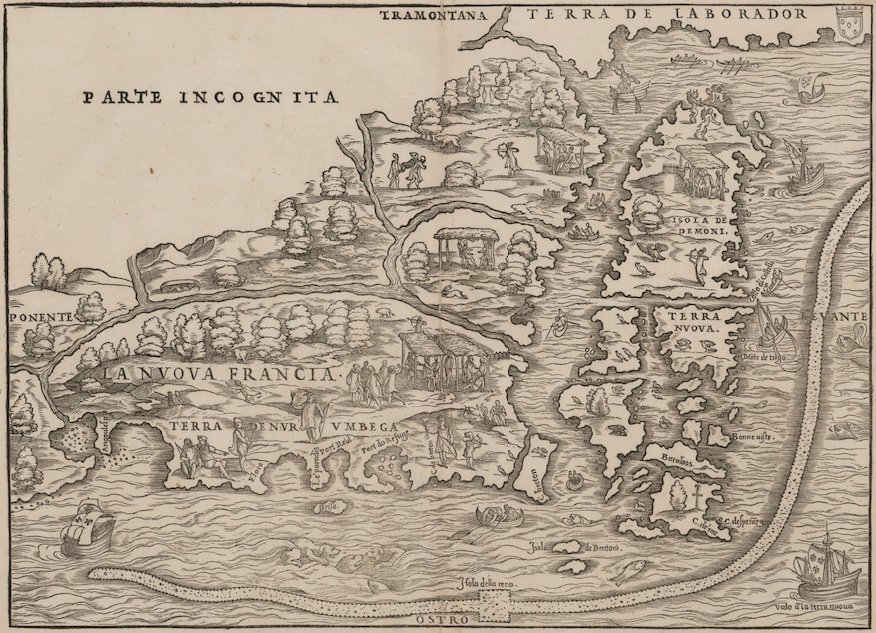
Where near Newfoundland, where Quirpon Island or Belle Isle lie.
When from the early 16th century to the middle of the 17th.
Also associated with Satanazes, another phantom island linked to the devil; and Harrington Island, on Quebec’s Côte-Nord1, which may be the Isle of Demons where Marguerite de La Rocque was marooned by her uncle Jean-François de La Rocque de Roberval in 1542.
They were all dead, her three companions and now Marguerite was all alone on the isle of Demons.
Her lover, François, had died first. He had fought for her, when the scandal had broken out on the ship. He had defended her. That had been courageous, but no one could oppose Roberval’s authority for long. Marguerite’s uncle was a cruel man, greedy and puritan, yet one who had managed to win the loyalty of the ship’s crew. Marguerite and François found few allies, except for Damienne, the maid, when the confrontation came. In the fight, François was hit on the head. The injury seemed harmless, but in the austere wilderness of the isle of Demons, his health worsened. The first few days of their abandonment, he was fine, he hunted, he loved. Then the delirium began. It ended only when his breathing did, at the coming of autumn, after several weeks of constant care. Damienne and Marguerite buried him in a crevice, far from the cave where they lived.
The nameless one died second. A girl, born at the end of the first winter. A frail, sickly child, malnourished, for her mother’s milk was clear. Marguerite could not bring herself to name a daughter that she knew would not live. Damienne cared for her as best as she could, but the nameless one died at the age of two weeks without having received the sacrament of baptism, or indeed without having seen anything but the desolate rocks of this sea of Newfound Lands. Marguerite put her body next to the bones of her father—the love and the fruit of the love, both destroyed by the wickedness of men and the brutal indifference of this cursed country.
Damienne died third, in the middle of the second winter. At that stage, the two survivors had exhausted the gunpowder that Roberval had given them, and the hunt was being done laboriously, by using the guns like bludgeons. Fishing and trapping were more efficient, but still, hunger lurked, ready to snatch them up at the first mistake. Damienne, who admired her mistress, often insisted to give her her share. Marguerite, moved by this sacrifice, would refuse—at first. But the grip of hunger was tightening. Soon, Marguerite ate half of the meat that should have fed her maid, and she even hid some of the products of her hunt. Damienne gradually faded. When Marguerite realized it, and wanted to sacrifice herself in turn, it was too late.
And now Marguerite was all alone in the isle of Demons.
The wind blew over the frozen rocks. A thick snow effaced the landscape. Damienne’s body had to be moved to the crevice, with the others, but Marguerite no longer had the necessary strength. She would wait for springtime. Until then, she would live alone in this cramped cave, the entrance of which was guarded by a corpse that, thanks to the cold, did not putrefy.
Marguerite thought of letting herself die. Her food reserves shrank faster than she could resupply them. There were still several winter months until the snow melted, fish could be caught, and bushes covered themselves with berries. Several months before she could hope for the passage of a ship, whether Basque fishermen or her uncle, who, after having established his colony, would be overcome with remorse and would come back for her.
But no: Roberbal was not one for remorse. More likely, he hoped to be rid of her for good, so that he could, when he went back to France, inherit her fortune. Her death would be to him a victory. She would not give it to him.
Marguerite kindled a fire, a much bigger one than reason would have allowed—for wood was getting rare. She armed herself with a sharp stone and left the cave. The corpse of the maid lay there still, in a sitting pose, sheltered from the snow but not from frost. With the edge of the stone, Marguerite began hitting the hollow of Damienne’s elbow. The forearm came off. Back by the fire, Marguerite roasted it and ate a mouthful.
A moment later, she threw up. But hunger is a harsh mistress, and Marguerite persisted. She ate all of the flesh, up to the phalanges of the hand. When she was done, she went outside again and carved Damienne’s entire body in small pieces that she left in a cold place for conservation. She ate them one by one over the next few weeks. She regretted not having done the same to François. Perhaps the nameless one would have lived if, like an insect, she had devoured her lover.
The sailors called this place the isle of Demons, but why, Marguerite hadn’t understood at first. This rock in the sea looked like any other. There were no creatures from hell. Not even any Indians. Only desolation, and snow, and loneliness.
Yet the demons did roam. Now she knew.
Notes
-
home of the village of Harrington Harbour, where La Grande Séduction (Seducing Doctor Lewis) was filmed, among others ↩