Kianida
1467 – 1600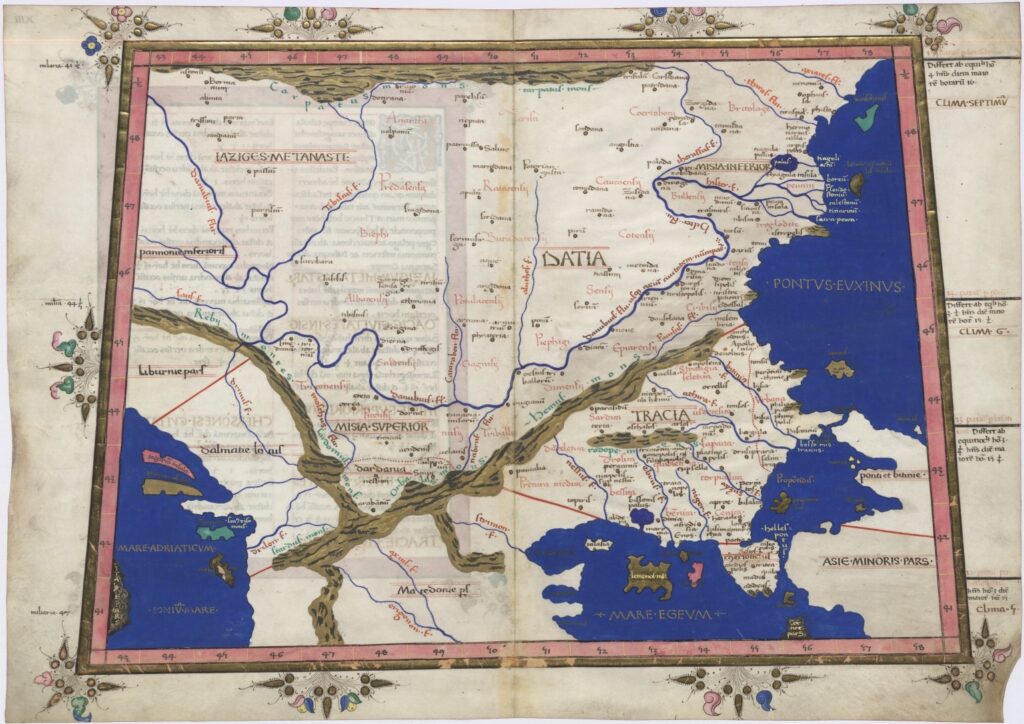
Where in the Black Sea, near Thrace and Bulgaria
When antiquity. Appears on maps based on Ptolemy’s descriptions. Possibly destroyed in the Middle Ages.
Also known as Cyanida, Cianeis Insula. Either way, the name refers to the colour cyan.
What follows is an interview with Eleni*, a resident of Rhodes, Greece. The interview was conducted in 2022 and then translated from Greek to English. At the time, Eleni was 84 years old. She has since passed away.
*Name changed to protect her family’s privacy.
You claim to have been born in a place called Kianida [Editor’s Note: also spelled Cyanida]. Can you tell us where that is?
Kianida was an island in the Black Sea, north of Istanbul and about 60 km east of what is now the Turkish-Bulgarian border. I say “was” because the island doesn’t exist anymore, not since the 1940s. I am part of the last generation to have been born there.
What happened to the island?
Its inhabitants decided to destroy it. They did it with explosives. It was during the war, so they managed to not attract attention.
Why did they destroy it?
To keep its secret. Kianida was concealed to the world for either 800 or 1,500 years, depending on how you count. When its people left it, they deemed preferable to erase all traces of its existence so that the secret would be kept. Now Kianida appears only on a few rare, old maps, and you call it a phantom island.
Are you able to tell us what the secret was?
Yes. We called it the Manteion. In your language you might say the Oracle.
The Manteion was what you would refer to, today, as a computer. It was built starting around 425 and perfected over the years. Of course, today, the science of electronics has allowed modern technology to surpass the capabilities of the Manteion, which was built using techniques that would seem primitive to you and I. But for centuries, Kianida was the location of the most advanced machine on Earth, by far.
Computers have been invented in the middle of the 20th century. At the earliest, we could say that Charles Babbage and Ada Lovelace came up with forerunners like the Analytic Engine in the 1820s. You’re claiming that computers came… a millennium and a half before that?
That’s right. I understand that this is surprising. That is because of the deliberate action of the Kianidans, who hid the power of their technology for all that time. But it’s true: mechanical philosophy — what you would call computer science or informatics — was a well-developed art in the Eastern Roman Empire in the 4th century. Many automata were constructed. The most famous one was the statue of the god Serapis, in the Serapeum of Alexandria. You may have heard of Hypatia?
Yes, she was a philosopher in Alexandria, and one of the first female mathematicians. History teaches that she was killed by a mob of Christian fanatics.
Your history is mistaken. Hypatia was one of us: a philosopher-mechanician. She was a founder of Kianida and died there at an advanced age.
Hypatia was also responsible for designing the Serapeum automaton. It was an impressive work of art and science. In the temple, a tall granite statue of Serapis stood, its hands outstretched. The god held a length of papyrus that extended to a roll hidden within the wall. Visitors could ask a mathematical question to the priests, who passed it on to the god through the use of levers and toggles in a back chamber. A few minutes later, the papyrus unrolled. The answer to the question could be picked up from the god’s hands. It was written as a series of small holes in the papyrus, a code that the priests were able to decipher and translate back into Greek or Egyptian.
You’ve probably guessed that the “god” was in fact an extremely complicated arrangement of gears made of bronze, of wooden rods, and of various switches. The driving force was provided by sacred bulls and slaves. The Serapis automaton was a massive engineering project. Hypatia and her father Theon spent years building and programming it. The Manteion would later surpass it, but at the time it was the crown jewel of mechanical philosophy.
There were similar but more modest automata in many other cities. However, not everyone had a favorable impression of such technology.
What happened?
As you alluded to, conflicts between the Pagans and the Christians were commonplace back then. Christianity was poised to displace the ancient religions in Alexandria and all over the Mediterranean. The Serapis automaton was seen as a pagan idol whose computations purpoted to replace the truth of the One God. It was burned down during the religious riots of 391, as were the rest of the Serapeum and other pagan institutions.
However, we shouldn’t conclude that only the Christians opposed Hypatia and the philosophers-mechanicians. Many Pagans had an uneasy relationship with the automata; to them, the machines imprisoned what must be minor deities into a cage of gears and spoked wheels. The Jews more or less shared the Christian views. Automata, wherever they were built, were recognized as a precious tool for business of military affairs, but they were also feared and often hated.
After the burning down of the Serapeum, the philosopher-mechanicians became a sort of secret guild. They carried on with their activities, but they were discreet. Yet Hypatia and some others wanted to build an automaton that would be even larger and more powerful than the Serapis one, and that could hardly remain hidden. After a few years, they found a solution.
Move to Kianida?
Yes. In the 420s, the philosopher-mechanicians enjoyed surprisingly good relations with the imperial court in Constantinople. The wife of emperor Theodosius II, empress Aelia Eudocia, was herself acquainted with mechanical philosophy, which she had learned in Athens. She convinced the emperor to grant the guild the right to take up residence on Kianida, a large but sparsely inhabited island north of the capital.
Philosopher-mechanicians from everywhere — Athens, Ephesos, even Rome — immigrated with their families and servants. Under the considerable moral authority of Hypatia, they founded a new, long-lasting society whose purpose was to build a new automaton: the Manteion.
Can you describe the Kianidan society?
It goes without saying that it changed a lot over 1,500 years. But overall, we could call it a technocracy. The council that governed the island was made up of the foremost philosopher-mechanicians: those that had made the most prominent contributions to the functioning of the Manteion.
Education was paramount, not only for philosopher-mechanicians, who were about a tenth of the population, but also for the supporting occupations. Fishing and agriculture were elevated to the status of sciences. That was necessary, becase Kianida has always been poor in natural resources. It survived thanks to the trade of a rare and precious commodity: information.
So Kianida traded with the outside world.
Yes, of course. In fact, for many centuries in the beginning, the Kianida colony was not a secret, although its true nature was known to only a few people at the imperial court. To everyone else, Kianida pretended to be a reclusive monastic community. That was not uncommon in the Byzantine Empire. Any visitors to the island — and there were not many — would see nothing but a few poor villages. To access the Manteion, which was built partially underground, you had to be initiated.
And yet the entire local economy rested upon the Manteion. The computations made by the Kianidans were useful to the emperor, who provided them with gold and silver in exchange for answers to his questions on astronomical or, more commonly, military matters. With this income, the Kianidans were then able to buy whatever they needed on external markets.
This sounds as if Kianida was a kind of secret research department of the imperial government.
We could say that, yes. At least at the beginning. We could also call Kianida an intelligence agency.
A computer is useful only to the extent that it has access to information it can process. Without intelligence from the rest of the world, the Manteion would have had no purpose. So the Kianidans developed a vast network of agents throughout the known world, from Western Europe to Persia, and later to India and China. Those spies brought back all sorts of information, such as new scientific knowledge, demographic data, and military intelligence. From this the Kianidans could improve the Manteion further, devise strategies to ensure their long-term survival, and provide the emperor with what he wanted to know.
Today, the Byzantine Empire still has a reputation of having been ahead of its time in the fields of diplomacy and espionage. Kianida was responsible for much of that reputation.
Let’s now get to the heart of the matter, if you will. What did the Manteion look like? How did it work?
Having never studied mechanical philosophy myself, I can’t describe it in detail. I do know that it was a true digital computer, and not a simple analog computing machine like the Antikythera mechanism. [Editor’s Note: The Antikythera mechanism is a complex machine used to compute astronomical positions, found in a shipwreck in Greece in 1901, and dated to the 1st or 2nd centuries BC.]
At first, just like the Alexandria automaton, the Manteion was mostly made of bronze and wood. With time, however, the Kianidans developed new techniques, or borrowed them from others. Steel, for example, allowed them to make smaller and more robust parts. They never reached the miniaturization level of electronic circuit boards, of course, but mechanisms similar to those used in clockwork could be used to make logical boards of reasonably small size.
Fundamentally, a computer must simply be able to execute a handful of logical functions: AND, OR, and NOT. Arithmetic operations, such as addition, are enabled by combining those basic functions. You should imagine the Manteion as a gigantic arrangement of tiny logical clockwork, made of small metal gears, which, when put together, are able to execute complex operations and store the results into a mnemonic system. All of this was set up within spacious subterranean chambers.
How was it programmed?
Variously, depending on the era. Somewhere in the last hundred years of Kianida’s history, they invented something akin to modern programming languages. They used typewriters for input and a sort of prototypical screen, made of thousands of small metal squares with a different color on each side, for output.
Before that there were many other methods. Punchcards. Large arrays of switches. A long time ago, they used a system of threads with knots and wooden beads. As you can imagine, it was often rather tedious to program the Manteion, and even more so to debug it! Compared to today, everything was painstakingly slow.
I’m especially fascinated by the idea that none of this used electricity.
Indeed. Electricity came to Kianida at the end of the 19th century, at the same time as it was harnessed everywhere else. Before, the Manteion had used energy from steam engines after they were invented in England. But of course, for most of its history, it depended on animal power, mostly, and human power sometimes. There were also windmills and watermills at times.
Let’s recap. Kianida was founded in the 5th century by people that you call philosopher-mechanicians, including the mathematician Hypatia. Then the island was for several hundred years home to a secret organization within the Byzantine Empire. Over many generations, the Kianidans built a gigantic computer and a spy network that allowed the Greeks to keep an edge over neighboring countries. But that must have ended, since the empire didn’t last forever.
Things went awry at the time of the Fourth Crusade, in 1204. The French and Italian crusaders split the empire into many small states and massacred the Greek population of Constantinople. A few individuals from the elite, as well as a small contingent of soldiers, fled to Kianida. The island was already fortified to protect the Manteion, which was undergoing an expansion project back then. It was a safe place.
During the next few years, the government of Kianida, having integrated the refugee aristocrats and imperial officials, implemented a new foreign policy. We wouldn’t depend on Constantinople anymore—or on anyone else. We would keep the island secret. Kianidan agents would keep selling intelligence to the various princes of Europe and Asia, and they would keep buying goods. But all this trade would now be conducted with the utmost subtlety.
It remains difficult to believe that you could keep a large island hidden for so long. What if a merchant ship on the Black Sea spotted Kianida?
Without exaggerating, the Kianidans were incredibly competent at this task! A fleet with no flag cruised the area, and attacked any ships that came too close. The Genoese and Slavic sailors quickly learned to avoid those pirate-infested waters. If a ship, despite this, came within sight of Kianida, the crew was forced to land and never allowed to leave. Meanwhile, Kianidan agents abroad kept watch for any rumors about the island and did whatever was necessary to prevent them from spreading. Also, any betrayal by a Kianidan was punishable by death, even on the other side of world. A well-known story told of a traitor in Damascus who escaped to China, only to be found and executed by one of our assassins days later.
The Manteion itself also helped. It was the basis for a cryptographic system that ensured safe communication between Kianida and its agents. And the machine could draw the best maps and portolan charts in the world. We would sell them cheap, and almost everyone in the region began using them. Of course, the charts did not indicate the presence of Kianida; instead they showed an area of dangerous reefs. We propagated the idea that those reefs were the remnants of a volcanic eruption that had devastated the island, which explained why older maps showed something here.
The Ottoman period made all of this simpler. The sultans forbade all foreigners from sailing in the Black Sea, so it was just a matter of having a few well-placed contacts to make sure the Turkish maritime routes skirted around the Kianida area.
And so the secret was kept until the destruction of Kianida in the 1940s, or rather, until today. I still have two possibly related questions. Why destroy the island and its Manteion? And why did you, Eleni, decide to reveal, well, all of this?
You’re quite right. These questions are related.
The heartbreaking decision to destroy Kianida was the result of many factors. One was the technological development of other countries. In the latter part of the 19th century, it was becoming difficult to keep the island secret when the telegraph and the telephone accelerated all communications. With the invention of flight, the task became even harder. A growing fraction of our efforts were devoted to it, to the detriment of the programming and improvement of the Manteion itself.
But more importantly, it soon became obvious that computers were about to be invented—or reinvented. For all sorts of reasons, including an ossifying bureaucracy and economic difficulties, early 20th century Kianida had become slow at innovation. The philosopher-mechanicians poured their energies into keeping up with the swift-paced science of the rest of the world. And the pioneers of modern computer science—the Alonzo Churches, the Alan Turings, the Konrad Zuses and the John von Neumanns—were going much faster than we were. They would soon catch up, and Kianida would no longer have any special advantage. It would lose its raison d’être.
Reducing the Manteion to rubble still seems extreme. Couldn’t Kianida simply reveal itself and become a normal country, or maybe join the Greek state?
Well, there were yet more factors. One of them was the tricky political situation, for instance between Greece and Turkey. Kianida would have made everything more complicated.
But—you’re right. The real cause for the end of the Manteion is something else. It’s actually quite ironic. The Kianidans destroyed their work for the same reason that the Alexandrians had destroyed the Serapis automaton: they were afraid.
Afraid of the Manteion?
Yes. Of its capabilities. Of its desires, if it had any, and if they could be different from ours.
You were afraid to lose control?
More or less. In fact, you should know that there were, in the 1920s and 30s, two political factions in Kianida. One of them, whom we might call the precautionists, was worried about the behavior of the Manteion as we were increasing its computing power. The other faction believed on the contrary that a more powerful Manteion would allow us to overcome the era of stagnation in which we seemed to be stuck. We shouldn’t slow down; we should accelerate.
The debates were sharp. The accelerationists accused the precautionists of repeating the mistake of the Christian fanatics in Alexandria. The precautionists countered that things had changed: the Manteion was now qualitatively different from from all automata that had been built before. There was no precedent, so caution was necessary.
Caution about what exactly? What made them think that the Manteion could be dangerous?
The precautionists believed that the Manteion had become complex enough that it could think.
The latest innovations in mechanical philosophy followed a new approach: the automaton itself determined the parameters to use in order to solve a problem. It was difficult to know how exactly the clockwork behaved, since the computer was programming them with no human input. The more we provided the Manteion with the ability to process large problems, the less we knew what was going on at the hardware level.
We never knew if the Manteion had truly become “conscious.” That wasn’t actually important. It answered our questions in fluent Greek, not in pre-coded output. We could speak with it as with a human, and its replies were usually correct and clever. We gave it all the data on the world that we harvested. It knew everything. But we didn’t know what was happening in its billions of tiny gears, so we gradually became less trustful. How could we know if it hid some secret goals? How could we be sure that it wasn’t manipulating us?
Couldn’t you simply deactivate the programs that were the most worrying?
At first, probably, yes. But the accelerationists went too fast for the other faction. It was almost certain that, somewhere in its memory, the Manteion had saved a copy of those programs. Perhaps we could have conducted a careful analysis of its mnemonic system, which at the time took the shape of giant magnetized discs, but then again the accelerationists would have been against that. There was no consensus in Kianidan society that we should amputate part of the Manteion.
So it was a political question.
Absolutely. The accelerationists held a narrow advantage in the council and in public opinion. Most of them thought that the precautionists’ fears were unfounded, or even laughable. They also pointed out that weakening the Manteion would be contrary to the very purpose of our society. What would Kianida even stand for if we stopped improving the Manteion? We might as well give up and leave.
Which is what happened eventually.
At the cost of great violence, yes.
A conflict between the two factions?
It began with an act of sabotage. A group of precautionists—my own father was among them—bombed a part of the Manteion. The automaton was far too large and spread out to destroy it completely without attracting notice, so they targeted the chambers of the mnemonic system in which the most critical programs were supposedly stored.
My father and four others were quickly arrested. Violence in Kianida was strictly prohibited, and sabotage was punishable by death. The accelerationist faction of the council, seeing an opportunity to reinforce its own power, decided to strike hard. Too hard, in fact. Way too hard.
They executed your father?
No, he was lucky to escape with just a bit of jail time. He almost certainly would have been executed, though, if the events had unfolded differently.
The accelerationists were led by a councilman named Isidoros. He was not satisfied with the arrest of five saboteurs. He suspected, and he was right, that there existed a vast conspiracy of radicals who wanted to wreck the Manteion into utter ruin. But he couldn’t simply arrest everyone who had voiced precautionist opinions; that would have been half the population. How could Isidoros know who was behind the bombing?
The attack, by the way, had failed. The Manteion still functioned as well as before—it had kept copies of almost everything that had been stored in the destroyed mnemonic chamber. Isidoros decided that he shoud use it. He asked the automaton to identify, in a database of all of Kianida’s citizens, who were the most susceptible to plotting against the state or hiding radical sympathies. The Manteion ran its opaque algorithms and found, by analyzing their behavior and demographic data, about a hundred suspects.
Isidoros had them all arrested. There were councilmen and councilwomen among them. There were some of the most highly regarded philosopher-mechanicians. There was also my mother.
That sounds very much like a political purge.
It was the late 1930s, and we knew very well what was going on in Germany, in Italy, and in the Soviet Union. The precautionists, but also many of the accelerationists, got scared. Life under a totalitarian regime sounded bad enough, but life under a totalitarian regime that was able to control its population thanks to a powerful and incomprehensible automaton—well, that was downright horrifying.
We took arms against Isidoros. There was a brief civil war—the only major conflict on Kianida in one and a half thousand years of existing.
Isidoros almost won. We think it’s because the Manteion itself felt that it must support him in order to survive and keep growing. Many weapons used for the island’s defense were controlled by the Manteion and turned against the precautionists. In the end, though, the precautionists were victorious, barely, thanks to strength in numbers. Few people were still allied with Isidoros after the horrors of the purge and the computer-backed war.
After the conflict ended, an extraordinary assembly was convoked. Isidoros and his entourage were condemned to death. Then there was the matter of the Manteion. That’s when we chose to dismantle it completely, to destroy the island—which had almost, with its endless underground galleries, become the Manteion—and to dissolve Kianidan society forever.
And to keep all of it a secret. Until today.
I should be clear—I am violating Kianidan law by disclosing this. A few years ago, that would have made me the target of assassination attempts. But there are almost none of us left, and I’m old already.
So why disclose it?
Because your computers have reached almost the same capabilities as the Manteion did at the end. You call that artificial intelligence. The world is already changing in response. You have philosophers and computer specialists who rejoice, and others who worry. The debates that took place in Kianida years ago are being enacted again, all over the world.
Ah, then I understand that you’re giving us a warning. We should, like you did, destroy our computers. Launch a Butlerian jihad, to use the words of the novelist Frank Herbert.
No! No, absolutely not. I want to give you the very opposite warning. You should not destroy your machines. Do not make the same mistake as the Alexandrians. Do not make the same mistake as us.
But—I thought you agreed with the precautionists!
I did, once. Not anymore.
Look at me. I’m one of the last representatives of a culture that worshipped progress. After the ruin of Kianida, our people dispersed all over the world, mainly in Greece, in the rest of Europe, and in North America. We assimilated. And what did the world gain from this? Nothing much. The countries of the world aren’t better because we sacrificed ours. At best, if the precautionists turn out to have been correct, we stalled the coming of artificial intelligence by a few decades. At worst, we put humanity on the path of stagnation and poverty.
There certainly exists some risk of a totalitarian techno-dictatorship. But it’s unclear that this risk is higher than in a society with no computers. If Kianida had chosen to keep going without improving the abilities of the Manteion, it would have had to transform into a strict regime that forbade the exploration of certain ideas. That could have been even worse than the Isidoros government.
And so you’re saying we should continue our efforts to develop artificial intelligence? Or even speed them up?
In Alexandria, both the Christians and the Pagans saw the automata of mechanical philosophy as insults to the divine. We were accused of playing God.
They were right to see the Serapis automaton as a god, even if it was a primitive one, with limited powers. But they were wrong about one thing. We were not playing. We were serious. With the Manteion and 1,500 years of efforts, we almost managed to become true gods—not to play, but to guide. Kianida could have been the source of immense knowledge and power, shepherding humanity towards a future with no poverty or disease.
So yes: speed it up. Do not repeat our mistake. Become gods. Quick.