Groclant
1507 – 1700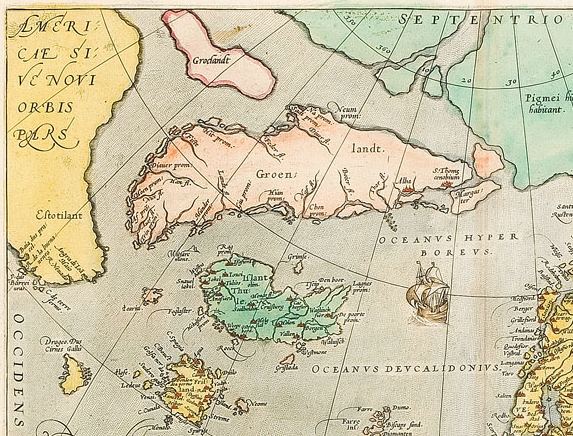
Where west of Greenland
When from about 1569 to 1608
Could be Greenland misspelled, or even Baffin Island
The Saga of Thorgils Leifsson
Thorgils Leifsson was the grandson of Erik Thorvaldsson, called Erik the Red, who, exiled from Iceland, explored for three years a new land that he called Greenland. Having described upon his return the promises of that place to the Icelanders, he attracted many of them and founded two settlements, one in the West and one in the East. In the latter he built the estate now known as Brattahlíð. Erik the Red had one daughter, Freydis, and three sons, Leif, Thorvald, and Thorstein. Leif became, for his feats of navigation, the most famed of the three. Having heard the account made by the merchant Bjarni Herjólfsson of his travels, during which lands beyond Greenland were seen from a distance, Leif Eriksson purchased his ship and led an expedition westbound. He visited the land seen by Bjarni, as well as two others; he called them Helluland, the Land of Flat Stones; Markland, the Land of Forests; and Vinland, the Land of Grapevines. Like his father before him, Leif founded a settlement in one of the new countries he had discovered. But the perils that Leif and his people encountered in Vinland forced them to head back to Greenland after two years. Other attempts at settlement were made, not by Leif but by other dauntless seafarers, yet all of them likewise ended after a short time.
From two women, Leif Eriksson had that many sons. To the second, Thorkell, Leif bequeathed the estate at Brattahlíð and the chieftainship of the Eastern Settlement. But the first, Thorgils, son of the noble Thorgunna from the Southern Isles, received neither honor nor wealth. Here is what we know of his fate.
Thorgils Leifsson did not become a beloved figure in the Eastern Settlement. Small of stature, with a face like that of a rat, Thorgils moreover had habits that were seen as queer, like that of speaking to himself. He lived in Vatnahverfi, where he owned a sheep farm. But his talent, which he had inherited from his father, was the skill of seafaring. In the summer, Thorgils led expeditions into the bays and fjords to the north of Greenland. There he and his men hunted the walrus, an animal of great worth for its tusks of ivory. So great was his skill of navigating in the most difficult conditions, that many of the hunters were devoted to him, even though they had no liking towards his person. Owing to his seafaring abilities, his men and him sometimes sailed north even in the late months of autumn, something which no one else dared do, for they feared the ice and the storms.
It was thus one moon after the autumn equinox that Thorgils and his men left the Eastern Settlement for a walrus hunt. On the way they stopped, as was the custom, in the Western Settlement. There they met a prophetess, a stubborn hag who refused the teachings of Christ and kept to the old gods. She warned Thorgils Leifsson thus:
“If you leave on this day, son of a seafarer, Much longer than you hope shall your travels last; For if wealth shows itself to the man of valor, From the foolish it can vanish fast.”
Thorgils, who was a Christian, did not heed the hag’s warning. His ship pressed onward, blessed with clement weather. In the north, his men found a bay of stony shores where there lived a herd of walruses more abundant than any seen around these parts in living memory. The hunt was excellent.
But on the sailing back, easterly winds began blowing strong, and the horizon disappeared behind a flurry of snow. Some of the more supersticious hunters remembered the pronouncements of the prophetess and believed that their greed had caused a punishment to befell them. But Thorgils, whose talent shone in such circumstances, had them cross the storm unharmed. When the winds and snow settled down, it was found that they had drifted away from the shores of Greenland. Believing that he was headed east, Thorgils sailed on until a land was sighted. This place looked like Greenland in all respects; but when the skies cleared up and the men saw that the sun set beyond the distant hills, they understood that they were on the eastern shore of a different land to the west. Since Thorgils saw neither flat stones, nor forests, nor grapevines, he knew that he had discovered a new country, that had never been visited by his father.
For three days, the hunters explored the new coastline, but they were not equiped for a lengthy expedition, and the nights of the late autumn were starting earlier and earlier. They sailed back to Greenland and returned to the Eastern Settlement. The ivory, as well as the skins and the meat of the walruses, were sold to traders, and this won Thorgils a hefty profit. But he knew that the true reward from his journey wasn’t this; and that to truly earn it, he had to prepare. He worked on his farm for two days, and then he went to Brattahlíð.
Unlike his stepbrother, Thorkell Leifsson enjoyed the respect and admiration of the people of Greenland. He had not inherited from his father the intrepidity of the sailor, but he administered the affairs of the Eastern Settlement with wisdom and reverence to tradition. Surrounded by a priest and some of his advisors, all of whom watched the newcomer with suspicion, Thorkell welcomed Thorgils to his estate.
“My brother,” Thorgils then said, “like our father Leif, son or Erik, and like our grandfather Erik, son of Thorvald, I have discovered a new land beyond the sea. I have come to you to ask that we prepare an expedition when spring comes, so that we can explore it and determine if it is suited for settlement.” Thorgils told the account of his travels and described in detail what he had observed. After this, the chieftain and his advisors conferred between themselves.
At length Thorkell spoke. “My brother, I thank you for having shared with us the tale of your adventures. However, it is our belief that the time for new discoveries had ended. We do not think it would be beneficial to send our men beyond the sea, neither next year, nor any other.” At these words Thorgils became angry. He accused his stepbrother of abjuring his ancestors, who would have favored the project. But Thorkell was impassive. He stood up and had his retinue follow him outside. It was snowing. He pointed to the white summits of the mountains that surrounded the fjord.
“Do you see this land, Thorgils, son of Leif?” he asked. “Do you know its name?” Thorgils replied that it was called Greenland. “Yet this land is not green,” Thorkell continued. “It is white, and grey, and sometimes brown. Do you know why our grandfather, Erik the Red, gave it this name?” “I do not know,” said Thorgils. “He named it thus to attract the people of Iceland, the land of ice,” said Thorkell. “And yet Iceland is greener than Greenland, and less icy. Here, only a few small regions can grow barley and sustain our flocks of sheep. Our grandfather founded our country upon a deception.”
They went back inside the house, and Thorkell kept talking. “Our father, Leif, son of Erik, did no different when he came back from his travels. I was closer to him than you were, and he confessed to me that Markland, the Land of Forests, was home to no great trees: everything that grows there is frail and scarce. As for Vinland, it is not a land of plenty either. At most, one can find bushes yielding small and tasteless berries, not grapevines and certainly no wine.” Thorgils’ anger did not abate. “Why do you sully the exploits of our family?” he asked. “Why do you insult the memory of our father and grandfather? How ill-advised Leif was to bequeath to you authority over our people!” Thorkell ordered him to leave; Thorgils did so, but with a gesture so rude that we shall not describe it here.
During the winter, Thorgils devised a plan to leave despite the opposition of his stepbrother and chief. He prepared his ship and attempted to put together a crew. But none of the men agreed to join him, not even the hunters who had seen the new land. In the spring, he announced that since no man was courageous enough to follow the exploits of Erik and Leif, he would leave alone. Thorkell tried to stop him, to no avail. One moon after the equinox, Thorgils left the Eastern Settlement on his ship, equipped for a single sailor.
Thorgils Leifsson was last heard of when he stopped in the Western Settlement. To the men assembled on the docks, he explained his plan and invited anyone who was thirsty for great deeds to come with him. Once again, none did. On a hilltop nearby, the old prophetess stared at him intently. When the son of Leif noticed, he quit trying to persuade the villagers. He went to the church for prayer and spent the night.
The next day, on a misty morning, Thorgils Leifsson left the fjords of Greenland, westbound. The villagers saw him vanish within the fog that covered the sea. On her hilltop, the old hag was shaking her head with sadness. The following Sunday, she was seen at church for the first time.